What Goes Into Preparing a Site for a New Foundation
Whether you are building a new home, adding an addition, or replacing a failed foundation, the site preparation phase is one of the most important steps in the entire project. A foundation is only as good as the ground beneath it — and in the Ottawa Valley, our variable soil conditions and deep frost penetration make proper site prep especially critical.
Here is what homeowners should know about preparing their property for a new foundation pour.
Step 1: Survey and Layout
Before any equipment arrives on site, the foundation location needs to be precisely staked out according to the building plans. This typically involves a professional surveyor who will mark the exact corners and establish elevation benchmarks. In Ontario, your building permit will specify required setbacks from property lines, and the surveyor ensures these are met.
For additions and replacement foundations on existing properties, this step also involves identifying the location of underground utilities — water lines, sewer/septic, gas, electrical, and communications. In rural Ottawa Valley areas, well lines and septic system components are common concerns. Ontario One Call (1-800-400-2255) should always be contacted before any excavation begins, but your contractor should also verify locations independently.
Step 2: Excavation
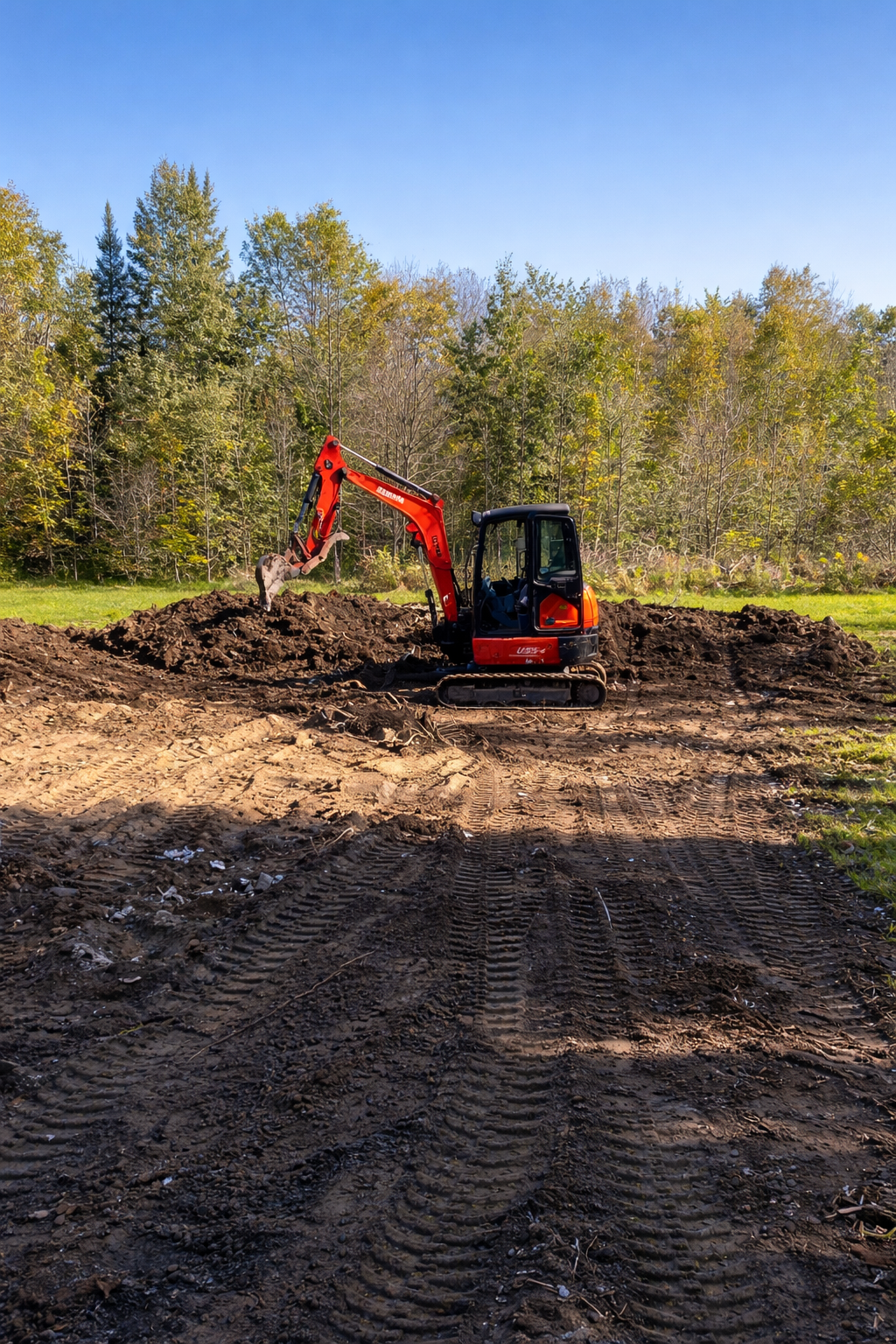
Excavation is where the real physical work begins. The hole for your foundation needs to be dug to the correct depth and dimensions, with enough extra room around the perimeter for forming, waterproofing, and drainage installation.
Depth Requirements in the Ottawa Valley
The Ontario Building Code requires footings to be placed below the frost line. In the Ottawa Valley (Pembroke, Petawawa, and Renfrew County), the frost depth is approximately 1.2 to 1.5 metres. This means your foundation footings will be a minimum of 1.2 metres below finished grade — and deeper in some municipalities that have adopted more conservative local requirements.
This is not optional or negotiable. A footing placed above the frost line will be subject to frost heave — the upward force exerted by freezing ground — which can crack and displace the entire foundation.
Soil Conditions to Be Aware Of
The Ottawa Valley has diverse soil conditions that can significantly affect foundation work:
- Clay soils: Common throughout the region, especially in low-lying areas and near river valleys. Clay expands when wet and shrinks when dry, creating movement that can stress foundations. Clay also drains poorly, making waterproofing and drainage systems essential
- Sand and gravel: Found in areas with glacial deposits (common near Petawawa and parts of the Ottawa River corridor). Generally good bearing capacity and drainage, but may require deeper excavation to reach stable bearing soil
- Bedrock: In some areas — particularly the Canadian Shield fringe zones in northern Renfrew County — bedrock may be close to the surface. This can require rock breaking or blasting, which adds significant cost but provides excellent bearing
- Organic soil or fill: Must be removed entirely. You cannot build a foundation on topsoil, organic material, or uncompacted fill. All of this material gets excavated down to native, undisturbed soil
Step 3: Base Preparation and Compaction
Once the excavation is complete and you have reached suitable bearing soil, a granular base is placed under the footings. This typically consists of clear crushed stone (19mm or 50mm) that provides drainage beneath the footing, or compacted Granular A for the slab area.
Compaction is critical. Every layer of granular material should be mechanically compacted to achieve the density specified in the engineering requirements. In the Ottawa Valley's variable soils, this step cannot be rushed — inadequately compacted base material leads to settling, which leads to cracked foundations.
Step 4: Drainage and Waterproofing Preparation
Before the foundation walls go up, the drainage system needs to be planned. This includes:
- Weeping tile (perimeter drain): Installed around the exterior footing to collect and direct groundwater away from the foundation
- Sump pit: If the water table is high or drainage to daylight is not possible, an interior sump pit with pump will be needed
- Granular drainage layer: Clear stone around the weeping tile and under the slab to facilitate water movement
In the Ottawa Valley, where spring water tables can rise dramatically during snowmelt, a properly designed drainage system is not a luxury — it is a necessity. Many of the foundation moisture problems we see in older homes stem from inadequate or failed drainage systems.
How to Prepare Your Property
As a homeowner, there are several things you can do to prepare your property and help the project go smoothly:
- Clear the work area: Remove landscaping, fencing, sheds, or other obstacles within 3-5 metres of the foundation area. The excavator needs room to operate and material needs somewhere to go
- Confirm access: Concrete trucks and excavation equipment need a solid access route to the site. Identify the best approach and ensure any gates or narrow passages are widened if needed
- Arrange spoils disposal or storage: Excavated soil needs to go somewhere. Discuss with your contractor whether fill will be stockpiled on site for backfilling later or hauled away
- Notify neighbours: Foundation work involves heavy equipment, truck traffic, and noise. Giving your neighbours advance notice is courteous and helps avoid conflicts
- Confirm permits: Ensure your building permit is in place before work begins. Your contractor should not start excavation without a valid permit
What to Expect During the Process
A typical residential foundation project in the Ottawa Valley — from excavation to completed pour — takes approximately 1 to 3 weeks depending on the size, complexity, and weather. The general sequence is: excavation, footing pour, wall forming, wall pour, stripping forms, waterproofing, drainage installation, and backfill.
Find out more about our foundation and slab services and our excavation and site preparation capabilities.
At COA Concrete and Construction, we walk homeowners through every step of the process before work begins. We handle site prep, forming, pouring, and finishing — and we coordinate with other trades as needed. If you are planning a new build or foundation project in Pembroke, Petawawa, or anywhere in the Ottawa Valley, contact us for a free consultation and estimate.